
Flexible Fibres for Fusion
ATL and the UKAEA have collaborated on methods for applying interphase coatings onto nuclear-grade silicon carbide fibres whilst maintaining flexibility.
Work headlines:
Design and installation of a continuous fibre CVI reactor capable of depositing PyC coatings on SiC fibres.
Discovery of 10× faster PyC coating recipe.
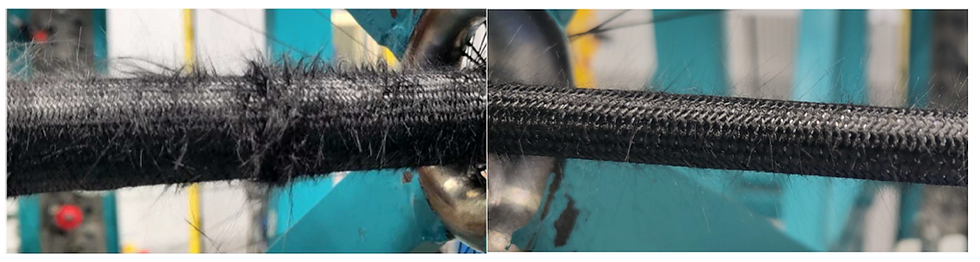
Fabrication of SiCf with a 5-layer interphase coating capable of being braided without damage.
In collaboration with the Materials Division at the UK Atomic Energy Authority (UKAEA), Archer Technicoat Ltd (ATL) have developed methods for depositing pyrolytic carbon (PyC) interphase coatings onto silicon carbide fibres whilst maintaining a level of flexibility suitable for braiding. With both batch and continuous coating procedures, the resulting coated fibres showed excellent handleability and successfully underwent filament winding trials at ATL and tube braiding trials at the Advanced Manufacturing Research Centre (AMRC). With advanced microstructural analysis at Imperial College London, we also developed fundamental understanding of the atomic structure and mechanical properties of carbon interphase coatings. This included discovering a recipe capable of increasing deposition rate by a factor of ten, which unlocks huge opportunities for the commercialisation of continuous PyC coating.
The coated fibres produced using this continuous fibre chemical vapour infiltration (CVI) technique are re-coated in protective sizing and supplied wound onto a spool ready to be formed into the final part geometry by braiding, filament winding, or weaving. This combination of continuous fibre coating and subsequent fibre handling techniques allows larger components to be produced as the final geometry is not limited by the size of the CVI reactor. Continuous process control can improve interphase uniformity across the component when compared to traditional batch processing where there may be non-uniform deposition. In this project, ATL designed and built a versatile continuous fibre coating reactor to deposit single-layer PyC coatings, with the capability to process multi-layer systems in the future that may facilitate tailored interphase design throughout composite components. A major drawback of the traditional PyC coating process for continuous reactors is its slow deposition rate, resulting in a winding speed around 5 mm/min. ATL achieved conditions allowing a winding speed of 100 mm/min in this project, and using the newly discovered recipe in the continuous fibre coating furnace would potentially reach 1000 mm/min, bringing it significantly closer to commercialisation.

Using a variation on the batch processing technique, ATL were able to produce 3 km of PyC-coated SiC fibre in one day, with <9% variation in the coating thickness. After in-house reapplication of sizing, the fibre was capable of being filament wound onto a twisted vane geometry and braided into a 10 mm diameter tube by the AMRC. Also included in this braiding process was a five-layer BN-based coating system, which currently can only be produced in smaller amounts, but represents the possibility for this processing route.

Dr Alex Leide, Senior Materials Engineer at UKAEA, commented “the innovative technology ATL have developed brings SiC/SiC composite components closer to use in fusion devices. By accelerating manufacturing speed while maintaining quality, the high temperature performance of ceramic matrix composites becomes more accessible.”


Comments